How to crochet your first amigurumi, from the first round to the last woven-in end, even if you still cannot tell where to insert the hook.
What stops a beginner is not the movement. It is losing the count without knowing where or when. One project, fourteen chapters, and a marker that tells you which round the error happened on.
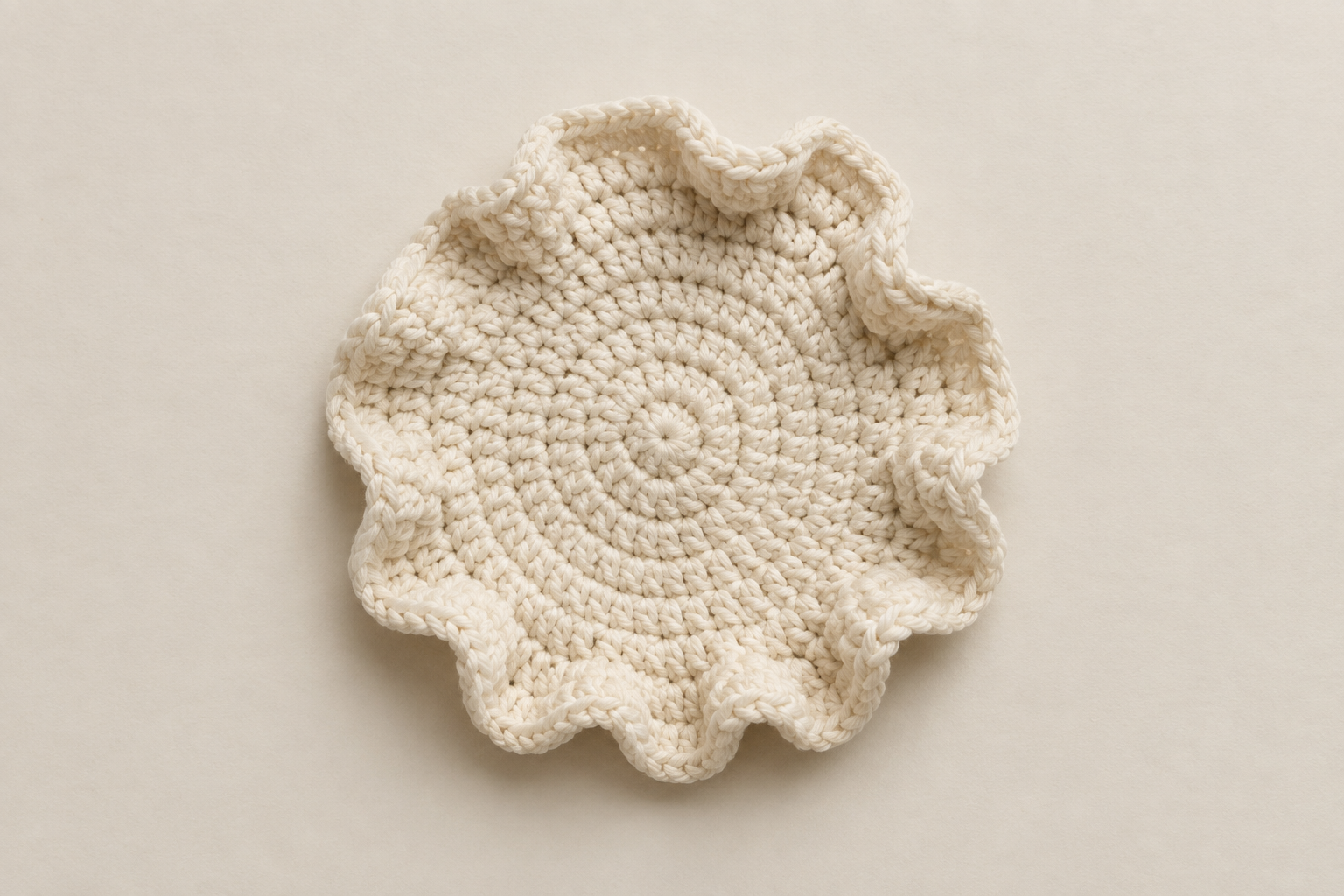
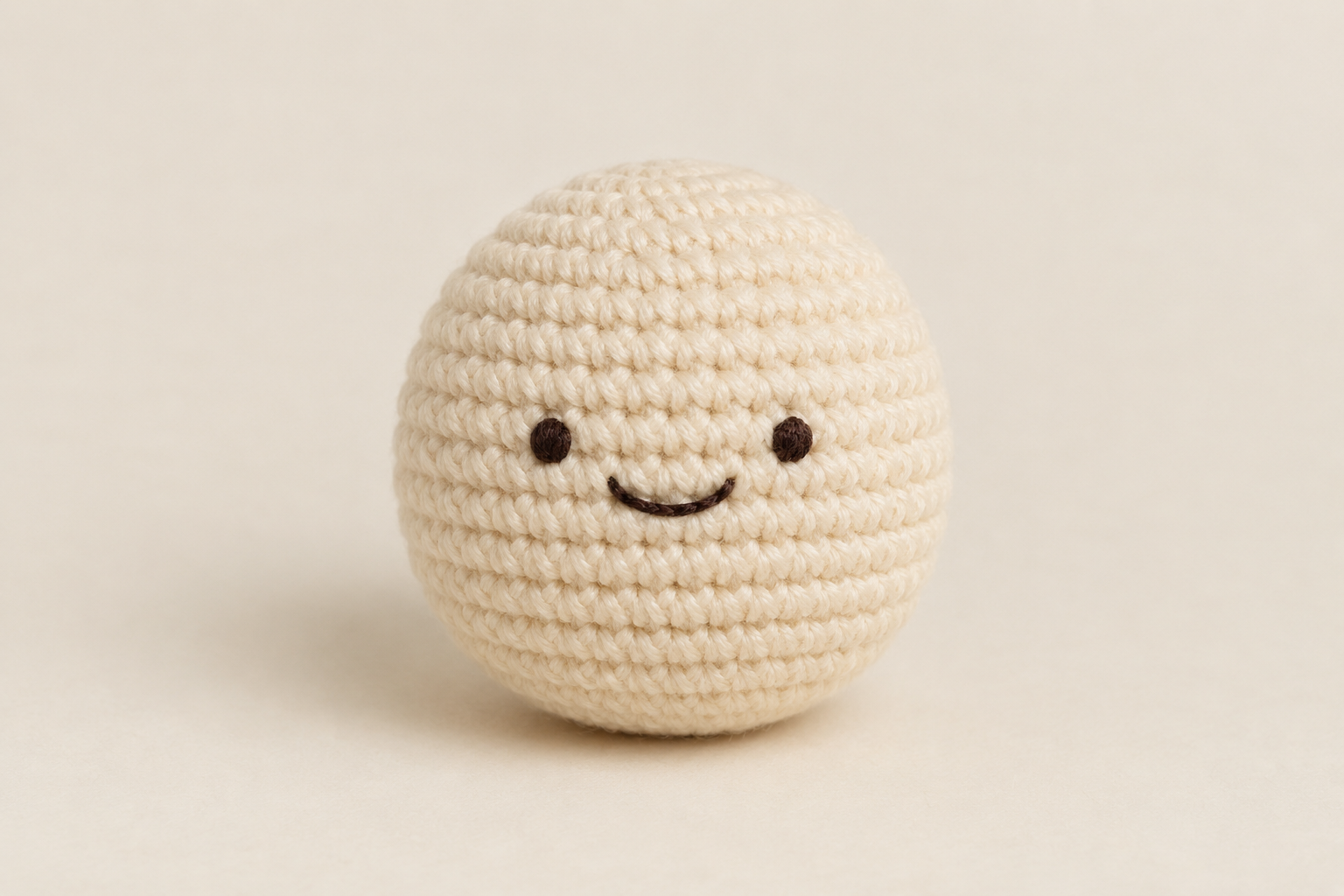
The difference is not in your hands. It is in what you check before you move on to the next round.
Keep reading if you want to:
- Finally see where to insert the hook, and recognize the V of every stitch instead of picking a hole and hoping it is the right one.
- Know which round your mistake happened on, and unravel one round instead of starting again from the ring.
- Get a circle that lies flat, then an even wall, instead of a piece that ruffles or caves in for no reason you can name.
- Finish a project completely: the stuffing, the closing, the ends woven in, not just the last line of the pattern.
- Follow a path written for left-handed crocheters too, with every movement shown the way it is actually worked, never a flipped photograph.
- Put your first amigurumi on the table, finished, and know you could make it again on your own.
From: Elodie Marchand
Crochet teacher and founder of The Crochet Method.
Location: Nantes, France.
If you have ever unraveled a whole piece, this page is for you
You followed a video. You made the ring, the six stitches, and the first rounds went well. Then, somewhere, the count stopped matching. Thirty-four instead of thirty-six. Or thirty-seven. No way to say which round it happened on.
So you pulled it all out. Not because the stitch was too hard, but because nothing in the fabric kept a record of what had already been checked.
That is exactly the problem this book deals with, and it deals with it before it even teaches you the single crochet.
What tutorials never show
An amigurumi pattern fits in a few lines. "Rnd 3: (1 sc, 1 inc) x 6." Six words, and everything is assumed to be clear. Where the round begins, which stitches count, what the parentheses mean, what happens when the total does not match: none of it is written down, because whoever wrote it already knows.
Videos film the hands. They rarely film the moment you stop to count, and never the moment you get it wrong. You watch the successful movement on a loop, and you conclude that the problem is you.
The problem is somewhere else. In a continuous spiral there is no seam, no join, no visible boundary between two rounds. Without a marker you put there on purpose, a stitch missed on round six is only discovered on round twelve, when it is too late to find it.
At that point you have two options
Option 1 is not really an option: it is more of the same. If repeating were enough, your first amigurumi would already be finished.
Option 2 takes three minutes to set up and works on every project after this one. That is what this book has you set up in chapter 7, before the body even begins.
The Crochet Method: you do not count your stitches, you keep a record of what you counted
Everything rests on one principle, easy to state and it changes what follows:
In practice, three markers, each with a different job:
- The running marker. It sits in the first stitch of the round you are working. It answers one question only: where to start counting.
- The running strand. A plain length of contrasting scrap yarn, brought front to back then back to front before each first stitch. It stays in the fabric and keeps the boundaries of the rounds already worked.
- The log. Before you move the marker, you write down the expected number and the observed number. A checked line means "this round was counted."
- The recovery. If the marker falls out, you do not pick the stitch that looks like the first one: you go back to the latest crossing of the strand that matches the last checked line, and you count one round.
That is the difference between unraveling a piece and unraveling a round.
Just imagine for a moment...
- Sitting down with your work in the evening, without the quiet fear that the count has already been wrong for three rounds.
- Spotting a discrepancy on the round it appears, undoing a few stitches, and carrying on five minutes later.
- Closing your first amigurumi, weaving in the ends, and setting it down finished.
- Opening a pattern you have never seen, reading "(2 sc, 1 inc) x 6" and knowing exactly what it asks for.
This book is written for the left hand as much as the right
Most courses show a right-handed movement and suggest holding up a mirror. That rarely works: it is not only the direction that changes, it is which hand holds the fabric, which hand feeds the yarn, and where the tail has to stay reachable.
Every movement in this book is written twice, in its right-handed path and in its left-handed path, each with its own illustration. You follow yours, start to finish, without ever having to flip an image in your head.
I am pleased to introduce my digital book:
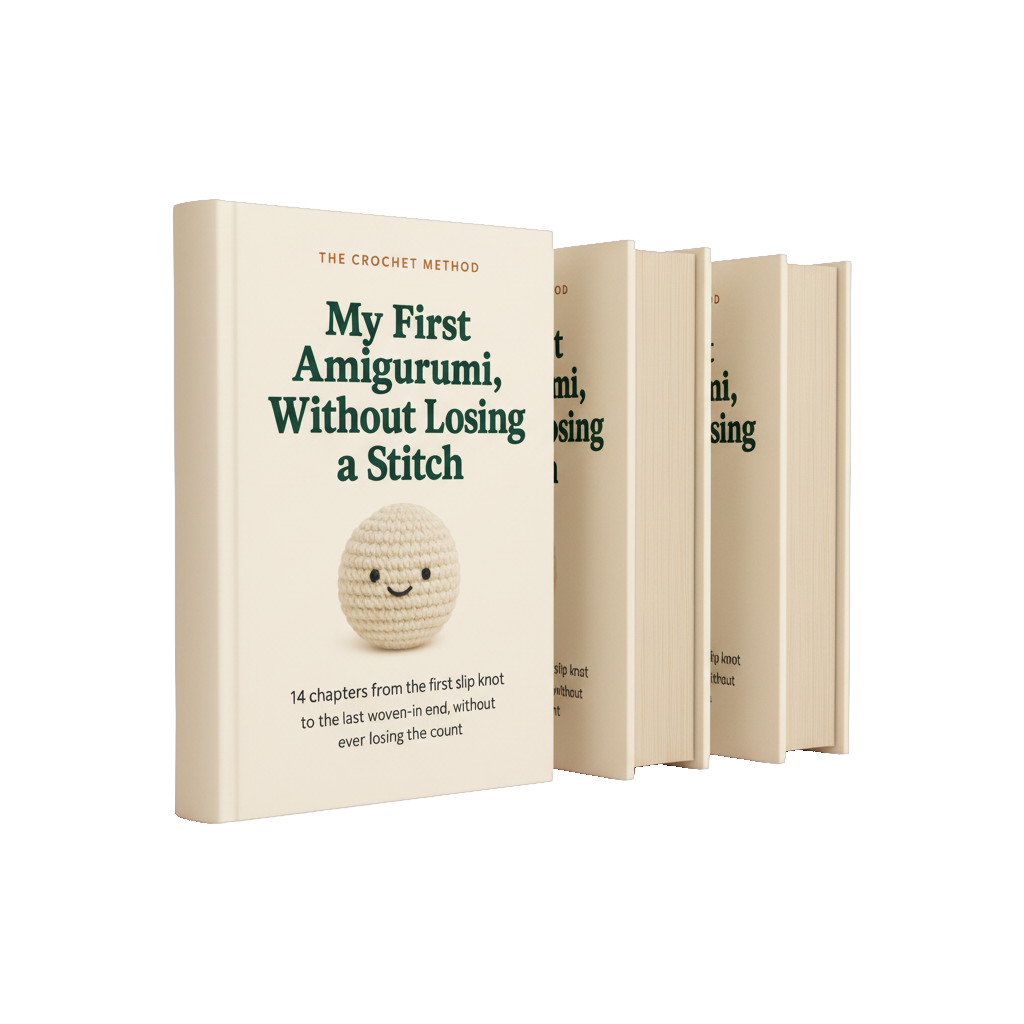
My First Amigurumi, Without Losing a Stitch: fourteen chapters that take you from the first slip knot to a project finished, counted and closed.
This is not a collection of patterns. It is a path around a single project, where every movement arrives at the moment it becomes useful, with the count to check before you continue. You are not reading a theory: you crochet, you count, you verify.
And it is a fully illustrated book: every movement has its close-up view, framed on the insertion point and on the strands involved, in both the right-handed and the left-handed path. No more abstract explanations, you see where the hook goes in and how many loops should be on it.
What you will go through, chapter by chapter
The move that changes everything fits in one sentence.
Before your second stitch, pass a plain length of scrap yarn through the first one.
Move it on every round and count again before you go on.
If the number is wrong, you unravel one round.
The rest of the book follows from that.
Ready to start?
Here is everything you get today
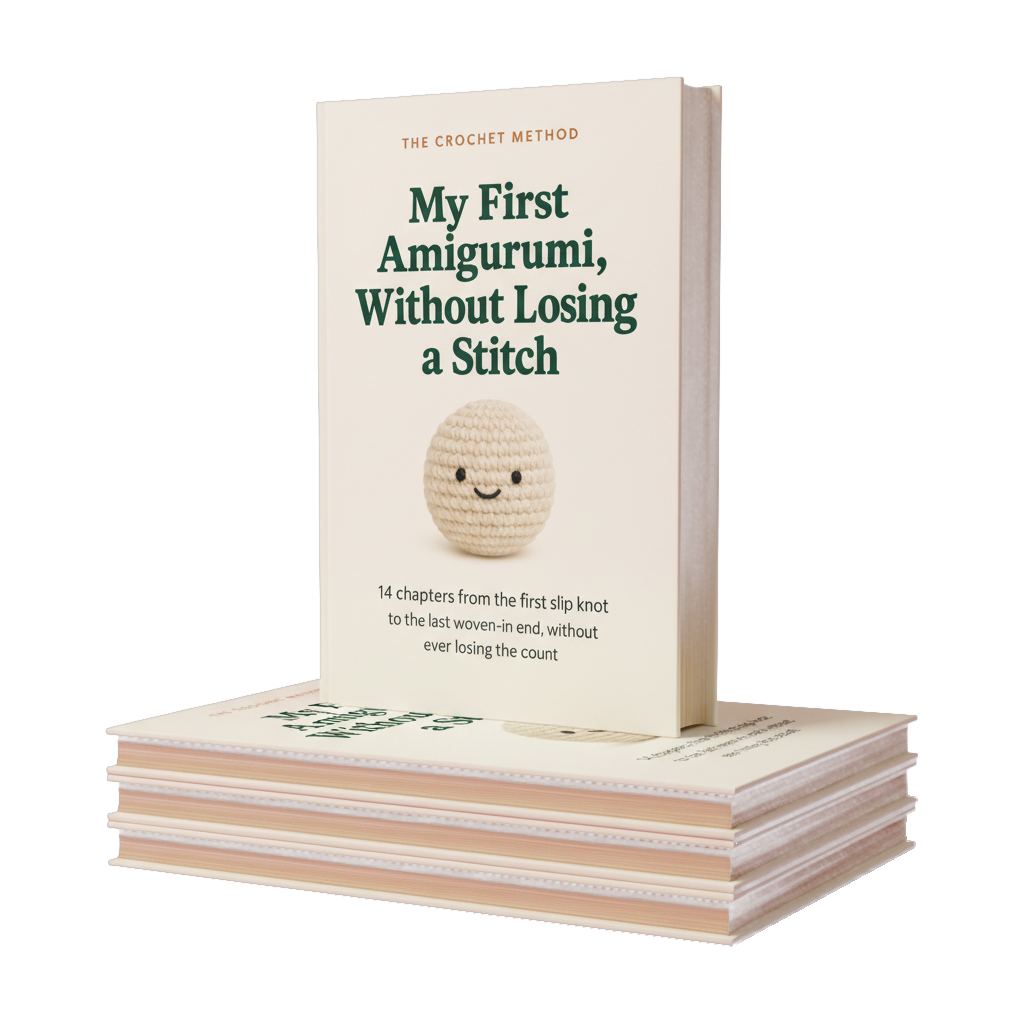
Everything is a PDF, to read on the phone beside you, or to print and keep next to your work. Here is exactly what you receive:
- The complete, fully illustrated book "My First Amigurumi, Without Losing a Stitch" in PDF, fourteen chapters, from the first slip knot to the last woven-in end (value $47)
- The left-handed path written and illustrated separately, movement by movement, never a flipped image (included)
- The complete Pico pattern, round by round, with the count to reach on every round (included)
- The printable log sheet: expected count, observed count, checked box (included)
- Lifetime access and every update, to read and print at your own pace (included)
Value: $47 → today:
This price will go back up to $47. Ordering today locks it at $17.
Our 30-day satisfaction guarantee
I know what it is like to unravel a whole piece and put the hook away. That is why I take all the risk off your side and put it entirely on mine.
Take the book today, read it, and above all do the exercises, one chapter at a time. If after 30 days you do not see a real difference in the way you follow a pattern, write us a simple email at contact@thecrochetmethod.com. We refund your purchase in full, no questions, no justification. And you keep the book you downloaded.
In other words: either this book moves you forward, or it costs you nothing.
P.S. Here is the summary: ordering today gets you the fully illustrated book "My First Amigurumi, Without Losing a Stitch" for $17 instead of $47. Fourteen chapters, one project, from the first slip knot to the last woven-in end, written for the left hand as much as the right. The principle: a correct count is worth nothing if it leaves no trace, and it is the trace that saves you from unraveling everything. And if within 30 days the book does not help you, you are refunded in full, no questions asked.
P.P.S. Remember: this price will go back up to $47. The worst thing would be to close this page and leave the hook in the basket again. The running strand costs a scrap of yarn and three minutes. That is all that separates a piece pulled out from a piece finished.